Buying guide - Teos Music
How to shaping the sound ?
Volume, presence, midrange, overall balance: two tools designed to act on the very structure of the signal, without imposed saturation or compromised precision.
Shaping your sound is a different level of control from overdrive. You're not adding saturation, you're not refining an existing drive - you're acting directly on it. signal structure level, frequency balance and presence in the mix.
That's the role of this range. Two tools, two complementary approaches. The 1985 Preamp is a totally transparent boost, without saturation or coloration: it raises the signal, reinforces the attack and pushes what's already there. The Midrange Equalizer is a 7-band equalizer designed specifically for electric guitar: not a generic EQ with wide, universal bands, but a tool focused on the frequencies where the guitar really lives in a mix.
Straight to the point:
- You want a pure boost, with no coloring at all → 1985 Preamp
- You want to precisely sculpt your midrange or correct an imbalance → Midrange Equalizer
Both share the same construction philosophy - 100 % analog, through-hole components, hand-assembly - but their role is distinct. This guide will help you understand which one is right for you, and why Midrange EQ isn't just “another EQ” in an already saturated category.
Straight to the point
You want to raise the level without changing anything else
Your sound is exactly what you want, you just need more level - to push your amp, feed another pedal, or simply have more presence.
To correct a tonal imbalance
There's a frequency that's in the way, a midrange that's missing, or your sound sounds different in a group than it does solo. You need a precise, frequency-by-frequency correction tool.
You want to sculpt your solo to make it stand out
You don't need extra overdrive for solos - just a different, more defined presence that cuts through the mix without changing the texture.
→ Midrange Equalizer (2 kHz / 2.5 kHz bands)
You want to optimize a pedal chain
You want an always-on that maintains a consistent, stable signal level throughout the pedalboard, without saturation, without compromise.
→ 1985 Preamp (buffered bypass)
You want to modify the behavior of an overdrive
Placed before or after saturation, Midrange EQ can move or attenuate a midrange hump, change the way overdrive responds, or adapt it to a different context.
What this range doesn't do
These pedals don't generate saturation, they don't color the sound in any characteristic way, and they're no substitute for a main overdrive. If you're looking for gain or crunch first, check out the other ranges.
Two tools, two levels of control
They are not competitors. The 1985 acts on volume and dynamics, without affecting the spectrum. The Midrange EQ acts on frequencies, with an additional level control. In certain setups, both have their place - the 1985 always active at the beginning of the chain, the Midrange EQ activated punctually or strategically placed around saturations.
The 2 pedals in the range
The most transparent boost possible: more level, more attack, zero saturation.
The 1985 Preamp is based on a radical principle: add nothing but level. No coloration, no accentuated midrange, no even slight saturation - just a stronger, more present, more dynamic signal. Its extended bandwidth makes it equally at home on guitar and bass.
At the vast majority of settings, it acts as a clean boost. At extreme settings, a very slight density may appear, linked to the natural behavior of the circuit, but without any marked coloration. Sound buffered bypass - non-switchable - maintains a stable signal throughout the pedalboard, making it a natural candidate for an always-on role at the beginning or end of a chain.
Controls : LVL (boost level), VOL (output volume). 9V DC power supply only. Available in black or pink. It's not the right choice if : if you're looking for any kind of sound coloration, or if you're looking to adjust frequencies rather than the overall level.
A 7-band equalizer focused on the mids that really count in guitar.
The Midrange Equalizer has not been designed as a generic “do-it-all” EQ. Precisely the opposite: a specialized tool, built around the frequency zones that determine the presence, placement in the mix and identity of the guitar midrange. Where many equalizers on the market cover very wide bands including deep bass or extreme highs of little use on guitar, here each slider has been chosen to meet a real musical need.
In other words, you don't end up with bands “there because they're needed”, but with a coherent selection of frequencies that are actually used for remove a veil, advance a solo, calm an invasive low-midrange or make a saturation more legible. It's this focus that makes the difference between a generic equalizer and a tool designed as a direct extension of a guitar pedalboard.
Sound overall level control allows it to act as a targeted boost too - pushing the whole signal while having already sculpted the spectrum. It can be placed before or after saturation, in both cases with musically different and coherent effects. It's not the right choice if : you're primarily looking to act on the extremes of the spectrum (deep bass or brilliant highs), or if you mainly need a simple boost without frequency work.
Comparison table
| Pedal | Type | Control | Main role | |
|---|---|---|---|---|
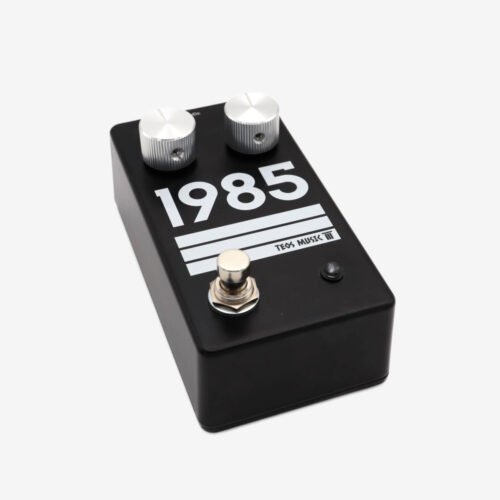 |
1985 Preamp | Boost / Transparent preamp | Overall level | Pure boost, always-on, signal stabilization |
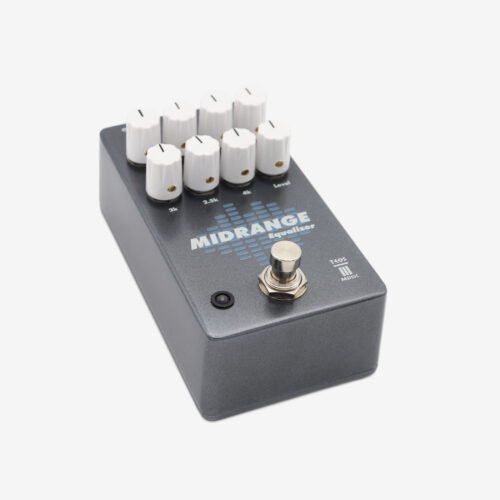 |
Midrange Equalizer | 7-band equalizer + Boost | Precise frequency | Sound sculpting, correction, targeted boost |
These two pedals are complementary and can be used together in the same pedalboard. Consult each product sheet for up-to-date information and prices.
How do I use them?
Where to place the 1985 Preamp in the chain?
At the beginning of the chain, it reinforces the signal before the other pedals - which may slightly alter how they react. At the end of the chain, it increases the overall output level. Its buffered bypass maintains signal quality whatever its position.
Midrange EQ before or after saturation?
Placed before an overdrive, it modifies the frequencies that enter saturation - changing the behavior and texture of the drive. Placed after, it acts on the saturated sound already formed. Both approaches are musically valid and give different results.
Using Midrange EQ for solos
Activated occasionally for a solo, it allows you to increase presence and definition without changing the gain pedal. The 2 kHz and 2.5 kHz bands are particularly effective for this purpose - immediate clarity and articulation.
Use both together
The 1985 always-on stabilizes the level and feeds the chain. The Midrange EQ manages frequency sculpting upstream or downstream of saturation. These are two different levels of intervention that complement each other without stepping on each other's toes.
→ 1985 + Midrange EQ
What about other ranges?
These two pedals can be integrated into any existing chain. Start by finding your main sound and your basic drive, then use these tools to refine what remains to be corrected.
A tool for precision, not character
These pedals aren't designed to define your sound - they're designed to refine it. If you haven't yet found your core sound, these tools will be more effective once you've established it.
→ Build your base first, shape later
Shaping your sound with precision
These two tools operate at different levels: one pushes without coloring, the other sculpts the frequencies that really matter in guitar. Discover now the dedicated selection to move from guide to practice.
See the pedals to shape my sound