Buying guide - Teos Music
What double overdrive
choose?
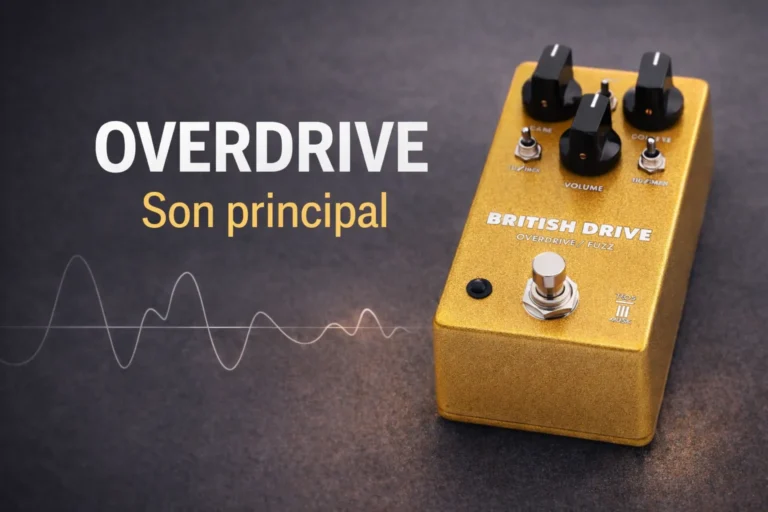
Two channels in one box, and above all three gain levels that can really be used: basic sound, drive, then stacking as a third channel. This guide helps you find the pedal that suits your playing style, without getting unnecessarily technical.
A double overdrive pedal for guitar answers a simple need: to obtain several levels of gain without multiplying the boxes on the pedalboard. It allows you to use one channel alone, the other channel alone, then both together to create a third sound.
But not all double overdrives meet the same needs. Some are designed to be immediate and obvious to use. Others offer more adjustment, more voicing, more control over how the gain is built up.
The real difference lies not only in the sound, but also in the way it is achieved: immediate simplicity, live control, or more advanced stacking construction.
Straight to the point:
- You want the simplest and most immediate →. Black Label
- You want an open base with more voicing settings → The Rudis
- You want to quickly change the mode of each channel live → Knight of Tone MKII
- You want to build precisely the role and interaction of each → channel. Black Pearl
All share the same manufacturing philosophy - 100 % analog, through-hole components, hand-assembly - but they don't require the same level of interaction or tell the same story underfoot.
A well-used double overdrive isn't two sounds - it's three.
Straight to the point
You want a pedal that's easy to adjust
Two complementary channels, one natural response, almost no decision required. This is the most immediate proposal in the range.
You want more margin without losing logic
An open rhythmic base, a more focused channel to push the lead, with voicing and clipping options to better adapt the response.
You often change context live
Each channel has an external Boost / OD / Distortion selector. It's the quickest to adapt without interrupting play.
You want to build your own stacking system
Clipping, channel roles, stacking order: the Black Pearl gives you the most freedom to build your third channel.
Simplicity or depth?
The Black Label is the most straightforward. The Rudis adds possibilities without losing its logic. Knight Of Tone favors live control. The Black Pearl requires more time, but offers the greatest freedom.
→ Immediate: Black Label - Adjustable : Rudis - Live : KoT MKII - Advanced : Black Pearl
What they all share
All allow you to play one channel alone, the other channel alone, then both together. On models with different circuits, the order of the channels also changes the interaction. On the Knight Of Tone, with its two identical sides, this question is less central.
→ Same format, but different usage philosophies
The range, from the most immediate to the most configurable
The more configurable a pedal is, the longer it takes to get to know it. This doesn't make it better or worse: it simply changes the way you arrive at the result.
The 4 pedals in the range
Open base + more focused lead channel
Interaction level
A double overdrive with clear logic, but with enough headroom to adapt it to your amp.
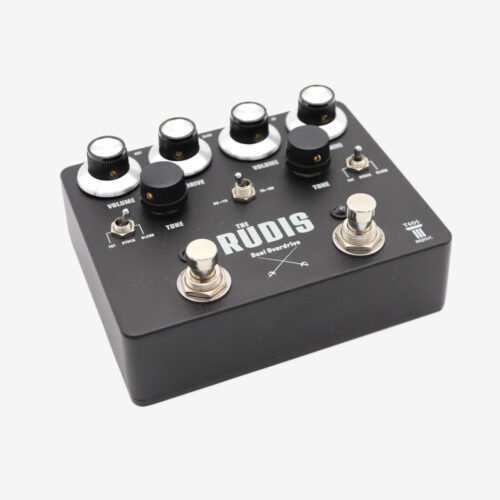
The Rudis offers a very legible duo: a left channel open and dynamic for the base, and a right channel more focused to push the lead. The idea isn't to reinvent everything, but to create a coherent pair of sounds that work quickly.
The voicing (Clean / Classic / MAX) and clipping options then allow you to fine-tune density, presence and response, without breaking this initial logic. It remains guided in its philosophy, but not fixed. Internal adjustments are also available to take things further.
In stacking, the base keeps the opening while the lead channel tightens and supports the signal. The result is a denser, more assertive third channel. Reversible order selector. True bypass. It's not the right choice if : you want the simplest possible solution, with the fewest possible settings.
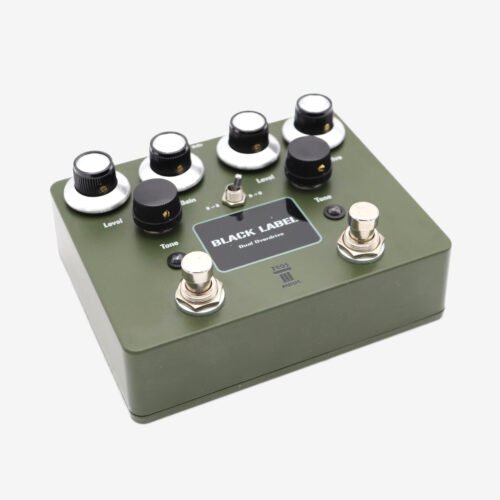
The easiest to handle
Interaction level
The most immediate of the range: few decisions, lots of naturalness.
The Black Label combines two channels designed to work effortlessly together. The Canal Bleu, in the Bluesbreaker spirit, brings openness, dynamics and a light sheen. Visit canal Vert, in an ODR-style logic, adds body, punch and denser saturation.
Its real strength lies in the fact that it quickly produces good results on different amplifiers, without requiring advanced settings. Apart from the channel order selector, there's nothing to complicate use. It's the most natural to get to grips with.
When stacking, both sides remain legible and balanced, like a credible third level of gain that's easy to exploit. Reversible order selector. True bypass. It's not the right choice if : you want lots of voicing and clipping options, or great freedom of construction.
Knight Of Tone Dual Overdrive MKII
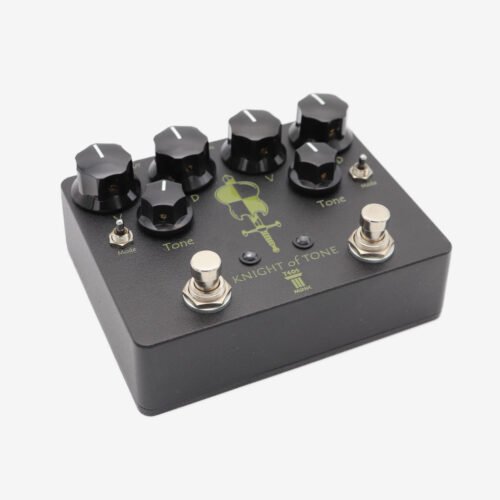
The fastest to adapt live
Interaction level
An organic double overdrive designed for those who often change playing modes.
The Knight Of Tone MKII immediately stands out for its 3-position external selectors on each channel. Boost, Overdrive or Distortion can be selected without opening the pedal. That's its real personality: being able to react quickly live.
With its two sides inspired by Bluesbreaker architecture, it retains an open, dynamic and touch-sensitive response. Internal dip switches then allow you to adjust the gain range, but the heart of the experience remains rapid control under hand and foot.
In stacking, the result is highly dependent on the mode chosen for each channel. With two identical channels, the question of order is less important than with models with different circuits. True bypass. It's not the right choice if : you're looking for the simplest pedal in the range, or a pedal with well-defined roles right from the start.
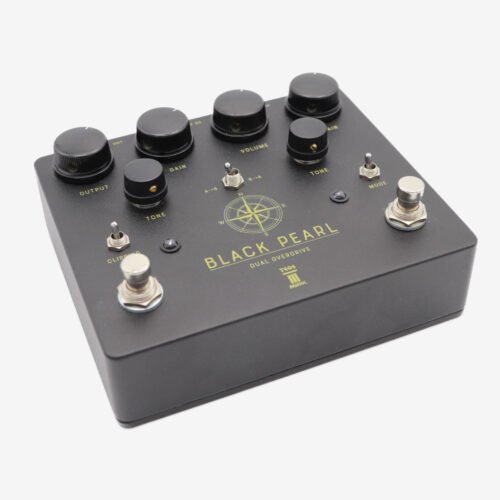
The freest way to build earnings
Interaction level
The most advanced of the range, for those who really want to build their third channel.
The Black Pearl doesn't start with a fixed duo. It starts from a more open idea: let each channel take on a different role depending on the clipping chosen, the stacking order and the way you want to build the gain. This is a pedal that can be adjusted with intention.
The side Klon-style can be used to tighten the bottom, add presence and improve legibility. The side Bluesbreaker-style then adds another layer of grain and dynamic response. Here, the result depends much more on your choices than on any predefined logic.
When stacking, it can be used to build a third custom channel. This is also what makes it more demanding: it requires more time, but offers the most control. Reversible order selector. True bypass. It's not the right choice if : you want a pedal that's immediate and obvious from the very first try.
Comparison table
| Pedal | Channels | Interaction | In brief | |
|---|---|---|---|---|
|
The Rudis | Tube Screamer + Bluesbreaker | Voicing + clipping | More margin without losing logic |
|
Black Label | Bluesbreaker + ODR-style | Very immediate | The easiest to handle |
|
Knight Of Tone MKII | Dual Bluesbreaker-style | External selectors + DIP switches | The fastest to adapt live |
|
Black Pearl | Klon-style + Bluesbreaker-style | Clipping + role + order | The freest way to build earnings |
This table serves as a quick reference. For further information, each product sheet details the pedal's personality and settings.
How to choose?
Do you want your roles to be clear?
Rudis and Black Label give a clear direction right from the start. The Knight Of Tone and Black Pearl require a little more choice, but also leave more room to adapt or build the result.
→ More direct : Rudis / Black Label
Do you play alone, in a studio or in a band?
All can work in a mix. The difference is in the way they do it: more guided presence on the Rudis, more neutral behavior on the Black Label, quick adaptation on the Knight Of Tone, finer construction on the Black Pearl.
→ Guided presence : Rudis - More built : Black Pearl
Do you often change settings during the set?
The Knight Of Tone MKII is the only one to switch modes directly on the front panel, channel by channel. This is its great advantage for live playing.
Rudis vs Black Label
The Black Label is simpler, more immediate and easier to adjust. The Rudis retains a clear logic, but goes further in the adjustment possibilities with its voicing and clipping options.
→ Simpler : Black Label - More adjustable : Rudis
Stacking: a third channel
Activating the two channels together doesn't just add gain. This is often the real heart of a double overdrive: a third channel in its own right, with its own response and dynamics.
The Black Label keeps it legible and natural, the Rudis makes it more assertive, the Knight Of Tone varies it according to the modes chosen, and the Black Pearl lets you build it almost entirely to order.
→ Readable: Black Label - More built : Black Pearl
What about other ranges?
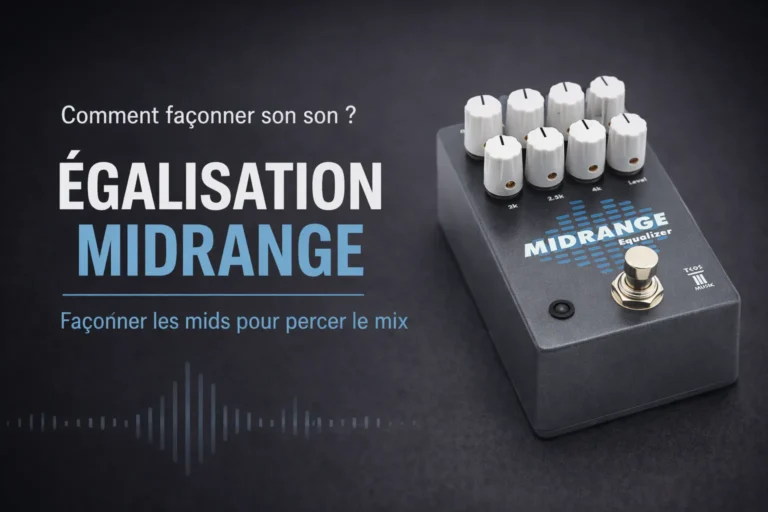
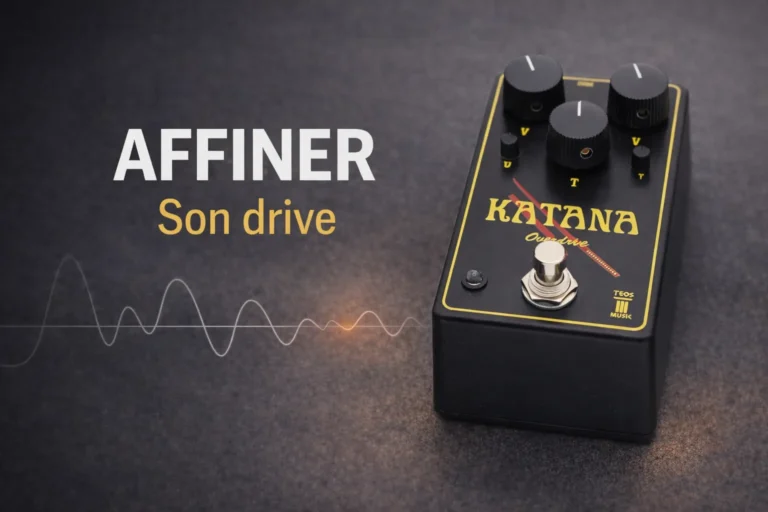
A double overdrive can become the heart of the gain on the board, then be complemented by a boost, EQ or finish pedal. A Centauride can help open up or refocus the lead. A Midrange EQ can refine the result after stacking.
Find your double overdrive
Four different approaches, the same format, and always the same idea: to offer several true levels of gain in a single pedal, with hand-crafted through-component manufacturing.
See double overdrives